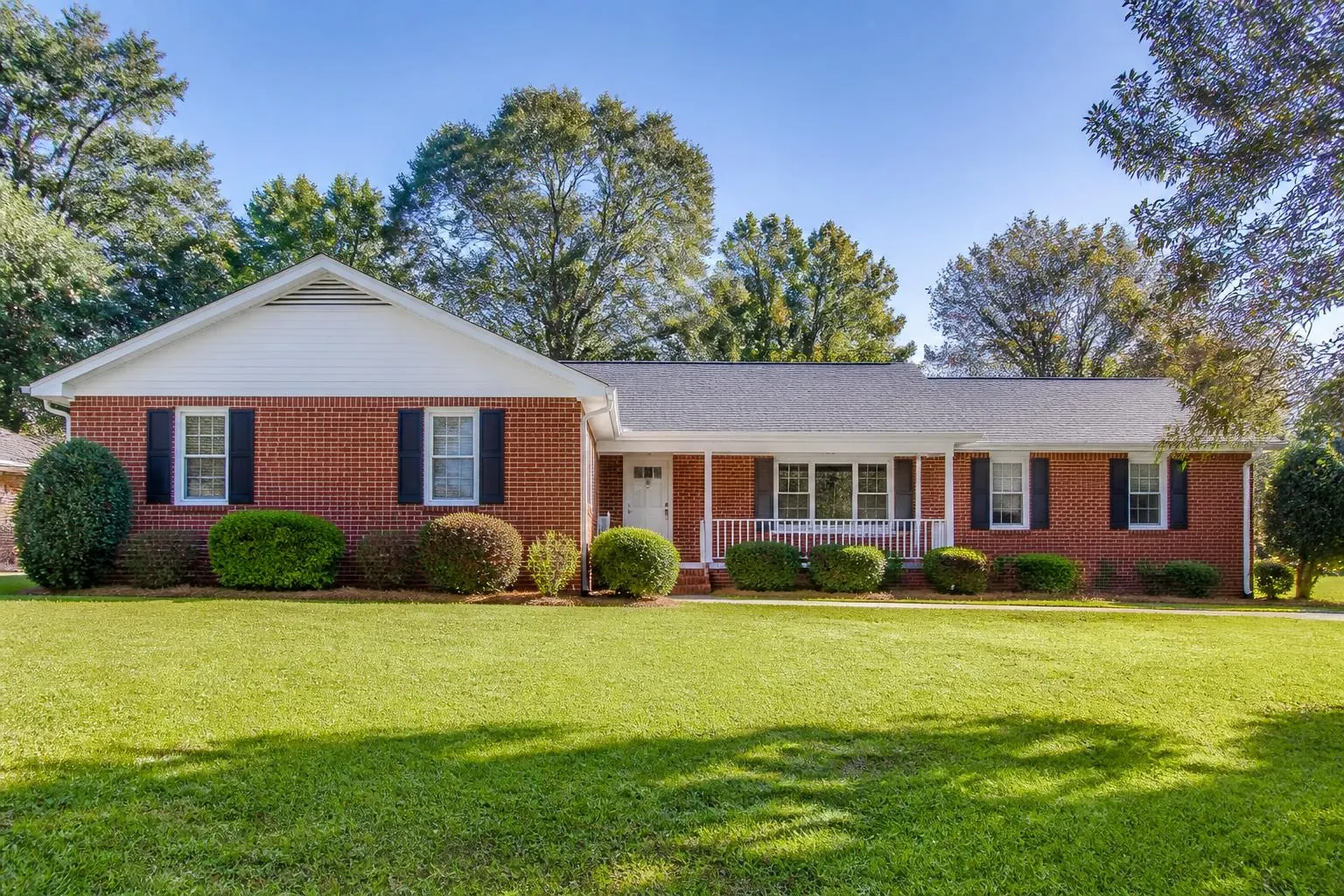
Housing Stock
Barclay Downs homes.
What is actually built here: the mid-century originals, the renovations, and the infill that replaced them.
Barclay Downs is a detached single-family neighborhood laid out on a flat, curving grid in south Charlotte, immediately west and south of the SouthPark commercial district. Almost every house in the platted neighborhood began as one of three mid-century types. What distinguishes the market today is how differently those houses have aged: an untouched original and a fully rebuilt house can sit on the same block.
The original mid-century stock
Construction began in the late 1950s on land that had been the Barclay dairy farm and continued through the early 1970s. The dominant house is the low, wide brick ranch: one story, a shallow hipped or gable roof, a carport or side entry garage, and a plan organized around a central hall. Alongside it sit split-levels, which use half-flights to add a lower-level den without a full basement, and two-story traditional and Colonial Revival houses with symmetrical façades, shutters and a centered front door.
These are solid, conventionally framed houses on level lots with mature willow oaks planted when the streets were cut. Their limitations are the ones common to the era: smaller kitchens, compartmentalized plans, modest primary bedrooms, single-pane original windows where they survive, and mechanical and electrical systems that have usually been replaced at least once. Read the architecture guide for how each style reads from the curb.
Renovated homes
The most common house on the market here is neither original nor new — it is a mid-century house that has been renovated, often more than once. Typical work includes opening the kitchen to a family room, adding a primary suite at the rear, replacing windows and roofing, upgrading electrical service and HVAC, and reworking the back of the house toward a covered porch or terrace.
Renovation quality varies enormously, and it is the single largest source of price spread inside the neighborhood. A cosmetic refresh and a structural whole-house renovation are described the same way in a listing. The renovation guide covers what to look for underneath the finishes.
Second-story additions and expansions
Because the lots are level and the original footprints are wide, many owners expand rather than move. Second-story additions over part of a ranch, rear additions, garage conversions and screened-porch or outdoor-kitchen projects are all common. Whether a specific expansion is feasible depends on the parcel's zoning district, setbacks, lot coverage, and any tree or stormwater requirements that apply — verify with the City of Charlotte before you plan.
New infill construction
New houses appear one lot at a time, generally after an original house is removed. They are typically larger and taller than what they replace, in transitional or traditional idioms, with attached garages, open plans and substantial outdoor living space. There is no subdivision of new homes and no builder inventory here; each build is a custom project on a specific parcel. See building and new construction for the process and constraints.
What varies street to street
Lot depth, curb setback, canopy density, proximity to Sharon Road or Fairview Road traffic, and the ratio of originals to rebuilt houses all change block by block. The street directory breaks the grid down individually, and the location guide explains how the perimeter roads shape the interior streets.
Buying into the mix
Because the housing stock is mixed rather than uniform, comparable sales in Barclay Downs require judgment. Two houses of the same recorded square footage can differ by a wide margin on condition and renovation depth alone. The home values page explains which variables actually move price here, and Barclay Downs real estate covers how the market functions.
Answers
Barclay Downs homes, answered
What types of homes are in Barclay Downs?
+
Barclay Downs is a detached single-family neighborhood. The original stock is mid-century: one-story brick ranches, split-levels, and two-story Colonial Revival and traditional houses built from the late 1950s through the early 1970s. Since the 2000s a large share of those houses have been renovated or expanded, and a smaller number have been replaced with new custom homes. Attached housing — apartments and condominiums — sits outside the residential grid, along the SouthPark commercial edge.
Are there ranch homes in Barclay Downs?
+
Yes. The single-story brick ranch is the neighborhood's signature house type and still accounts for a large part of the original housing stock, particularly on the interior streets. Many have been renovated, opened up at the rear, or given a second story.
Are there new construction homes in Barclay Downs?
+
Yes, but as scattered infill rather than as a subdivision. New houses are built one lot at a time, usually after an original mid-century house is removed, and must work within Charlotte's zoning, setback, and tree regulations for that specific parcel.
Are there townhomes or condos in Barclay Downs?
+
The platted Barclay Downs residential streets are single-family. Multifamily and condominium buildings in the immediate area are generally addressed to the SouthPark commercial district rather than to the neighborhood grid, so confirm the exact parcel before assuming a building is in Barclay Downs.