1957 — Present
A dairy farm, then a decade, then a city.
The making of Barclay Downs, and the mall that changed what it means to live here.
Before the streets, there were cows. The land that became Barclay Downs was part of the Barclay family's dairy operation, one of several working farms on the southern edge of Charlotte at a time when Sharon Road was a country road and the city's built edge stopped well short of here.
Postwar Charlotte grew fast and grew south. By the late 1950s developers were converting farmland along Sharon and Fairview into subdivisions aimed at the professional families moving into the city's expanding banking and textile economy. Barclay Downs was among the most ambitious: large lots, wide streets, curb-strip street trees, and an English naming scheme that gave the place an instant sense of establishment it had not yet earned.
What the 1960s built
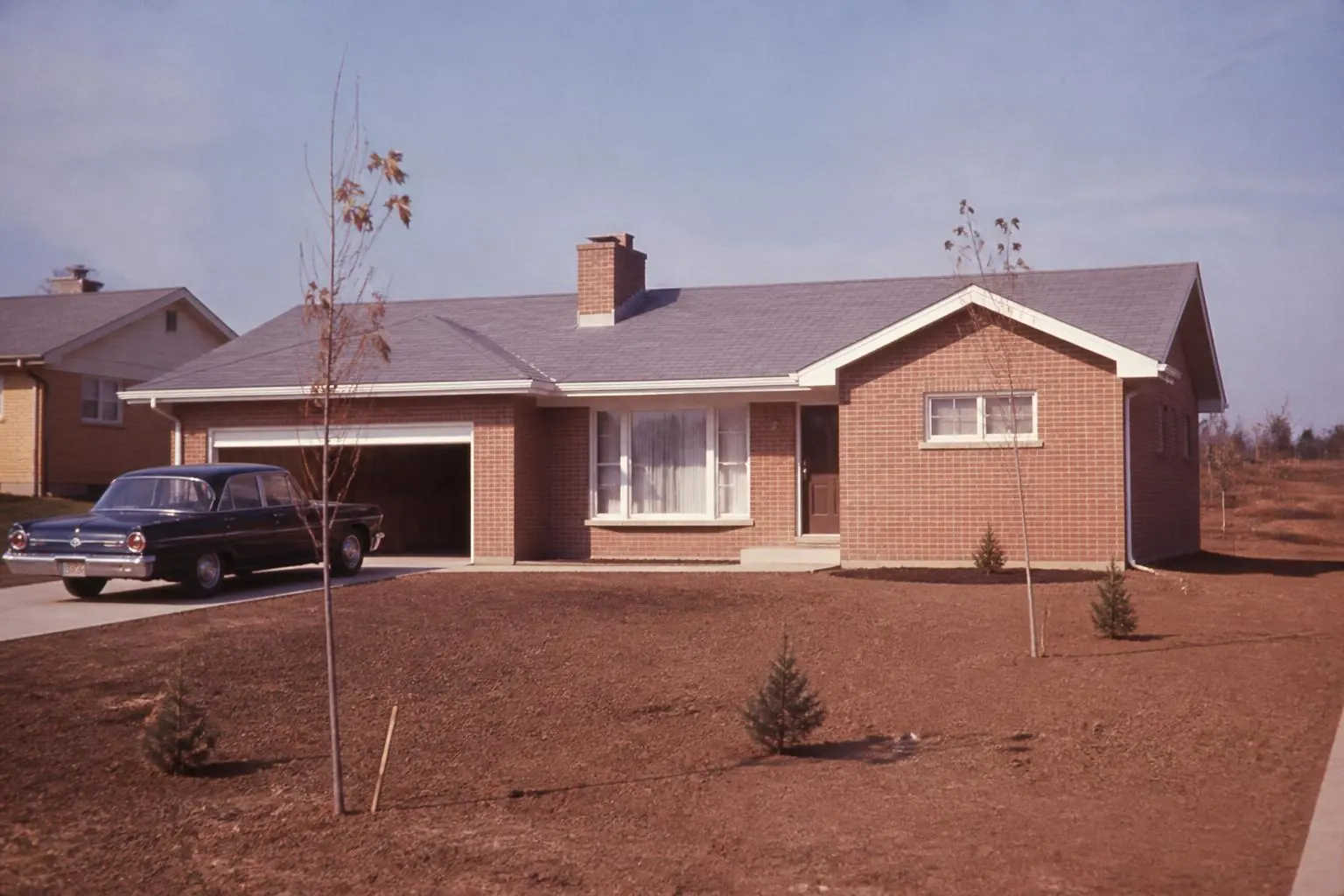
The original housing stock reflects exactly what an upper-middle-class Charlotte family wanted in 1963. Long, low brick ranches with attached carports. Split-levels that used Charlotte's gentle grades to stack a den under the bedrooms. Two-story Colonial Revivals with shutters and a center hall. Hardwood floors, plaster or early drywall, single-pane windows, and 1,800 to 3,200 square feet — generous then, modest now.
Those houses were built well. The brick is real, the framing is old-growth-adjacent Carolina pine, and the lots were graded to drain. It is the reason so many of them are still standing after sixty years of Charlotte humidity, and the reason renovation is often a better economic proposition here than in later, thinner-built subdivisions.
1970: the mall arrives
SouthPark Mall opened in 1970 on land immediately north-east of the subdivision, a joint venture on property associated with Charlotte's Belk and Ivey retail families. At the time it was a suburban shopping center at the city's edge. It did not stay that way.
Through the 1980s and 1990s the mall attracted the office towers, hotels, medical offices and restaurants that turned SouthPark into what planners call an edge city — a second downtown with its own skyline. Barclay Downs, which had been platted as an outlying neighborhood, found itself wrapped around one of the largest employment and retail concentrations in the Carolinas without having moved an inch.
The renovation era
By the early 2000s the arithmetic had shifted. Lot value in Barclay Downs had risen far enough that a 2,000-square-foot ranch was no longer the highest use of its parcel. The first response was renovation: kitchens opened, primary suites added at the back, carports enclosed, second stories popped where the roof structure allowed.
The second response, accelerating through the 2010s and 2020s, was replacement. Tear-downs produced 4,000- to 7,000-square-foot custom homes on lots that had held half that. The results vary — some are careful, well-scaled and deferential to the canopy; others are not — and the tension between them is the defining architectural conversation in the neighborhood today.
What has not changed is the reason people came in 1960 and come now: flat, generous lots under big trees, ten minutes from everything, in a city that keeps growing toward them.
Answers
History, answered
When was Barclay Downs built?
+
The first Barclay Downs sections were platted and built in the late 1950s, with construction continuing through the 1960s and into the early 1970s. Most original houses date from roughly 1957 to 1972.
Why is it called Barclay Downs?
+
The name comes from the Barclay family dairy farm that occupied much of this land before development, combined with the English 'downs' naming convention the developers used throughout the subdivision's streets.
How did SouthPark Mall change the neighborhood?
+
SouthPark Mall opened in 1970 on land immediately adjacent to the subdivision. Over the following decades the surrounding area grew into Charlotte's largest suburban office and retail district, transforming Barclay Downs from an outlying subdivision into the residential center of the city's second-largest employment node.