Comparisons
Barclay Downs, in context.
How the neighborhood stacks up against the places buyers usually consider alongside it.
Almost nobody looks only at Barclay Downs. The realistic shortlist for a buyer who wants an established south Charlotte neighborhood with mature trees usually contains four or five names, and the differences between them are real.
What makes Barclay Downs distinct
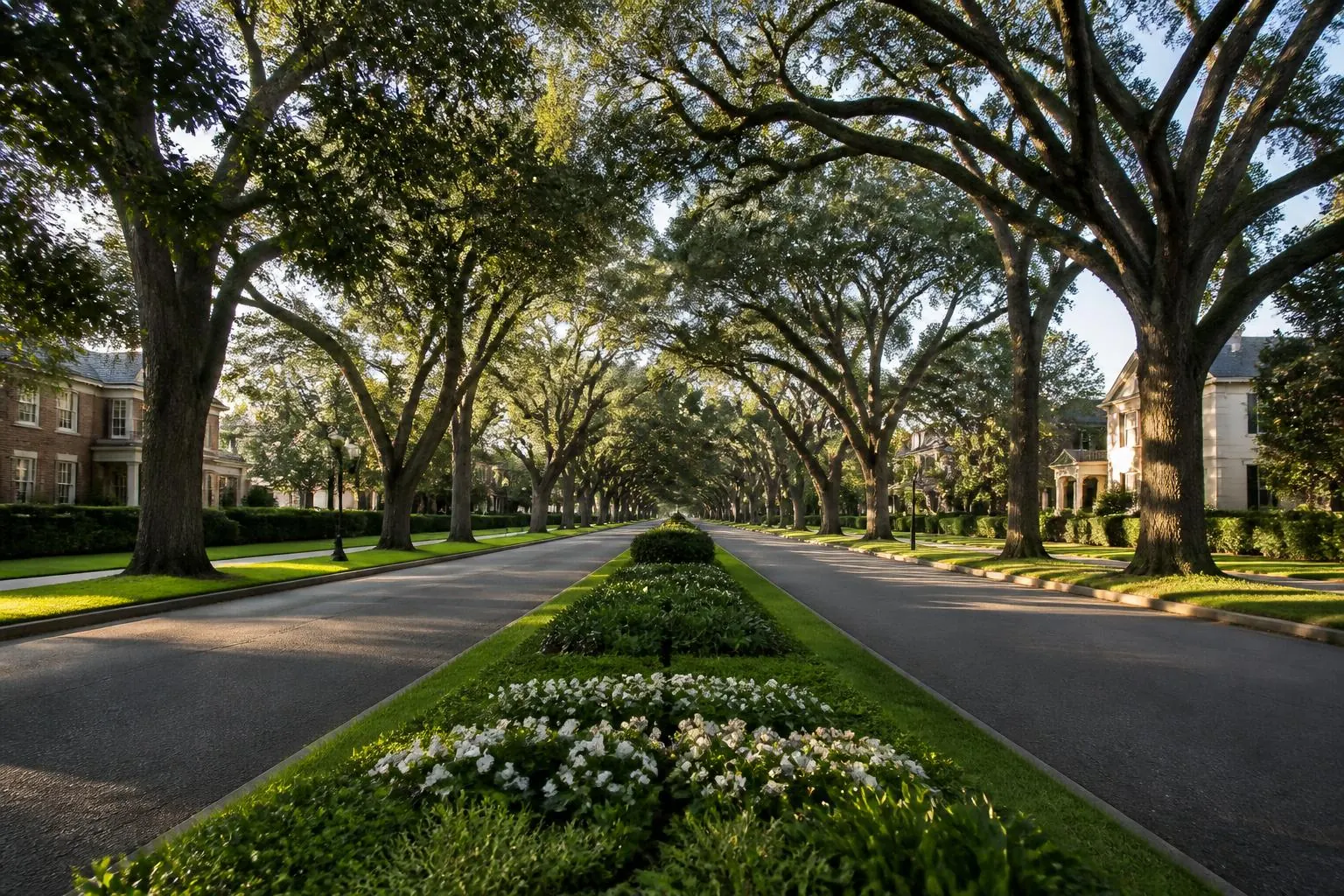
Three things: an unusually flat, quiet grid; a fully mature 1960s canopy; and immediate adjacency to SouthPark. No other established Charlotte neighborhood combines all three. The cost of that combination is a housing stock that is mixed rather than uniform, and traffic on the perimeter roads.
The alternatives
Myers Park
Older, grander and more expensive, with 1920s–30s architecture and Charlotte's most famous canopy. Less convenient to SouthPark retail; more convenient to uptown.
Foxcroft
Larger lots, more privacy, more rolling terrain. Quieter and less walkable, with a similar buyer profile and a comparable or higher price ceiling.
Eastover
Small, historic and tightly held. Closest in prestige to Myers Park, with far less inventory and almost no new construction.
Cotswold
The value alternative. Similar mid-century stock and similar convenience, at a lower entry price and with a less consistent streetscape.
Sedgefield / Madison Park
Smaller mid-century houses closer to South End. Younger buyers, faster turnover, more urban energy, less canopy.
Ballantyne / Providence corridor
Newer, bigger, cheaper per square foot and further out. Trades walkability and mature trees for space and newer construction.
Head-to-head guides
- Barclay Downs vs Foxcroft — land and privacy against convenience and a flat, buildable grid.
- Barclay Downs vs Sharon Woods — two established neighborhoods on either side of Sharon Road.
- Barclay Downs vs SouthPark — why a residential subdivision and a commercial district keep getting confused.
- Barclay Downs vs Myers Park — mid-century buildability against 1920s architecture.
How to choose
If you want architecture, choose Myers Park or Eastover — a dedicated Myers Park neighborhood guide goes deeper into that housing stock than a comparison page can. If you want land, choose Foxcroft. If you want value, choose Cotswold. If you want to be able to walk to dinner from a quiet street under sixty-year-old oaks, there is really only one answer, and this is it.